OneTrust: High-Impact Risk Management
Driving product evolution by synthesizing insights from $4.6M ARR customer accounts into a data-backed roadmap and modular design architecture.
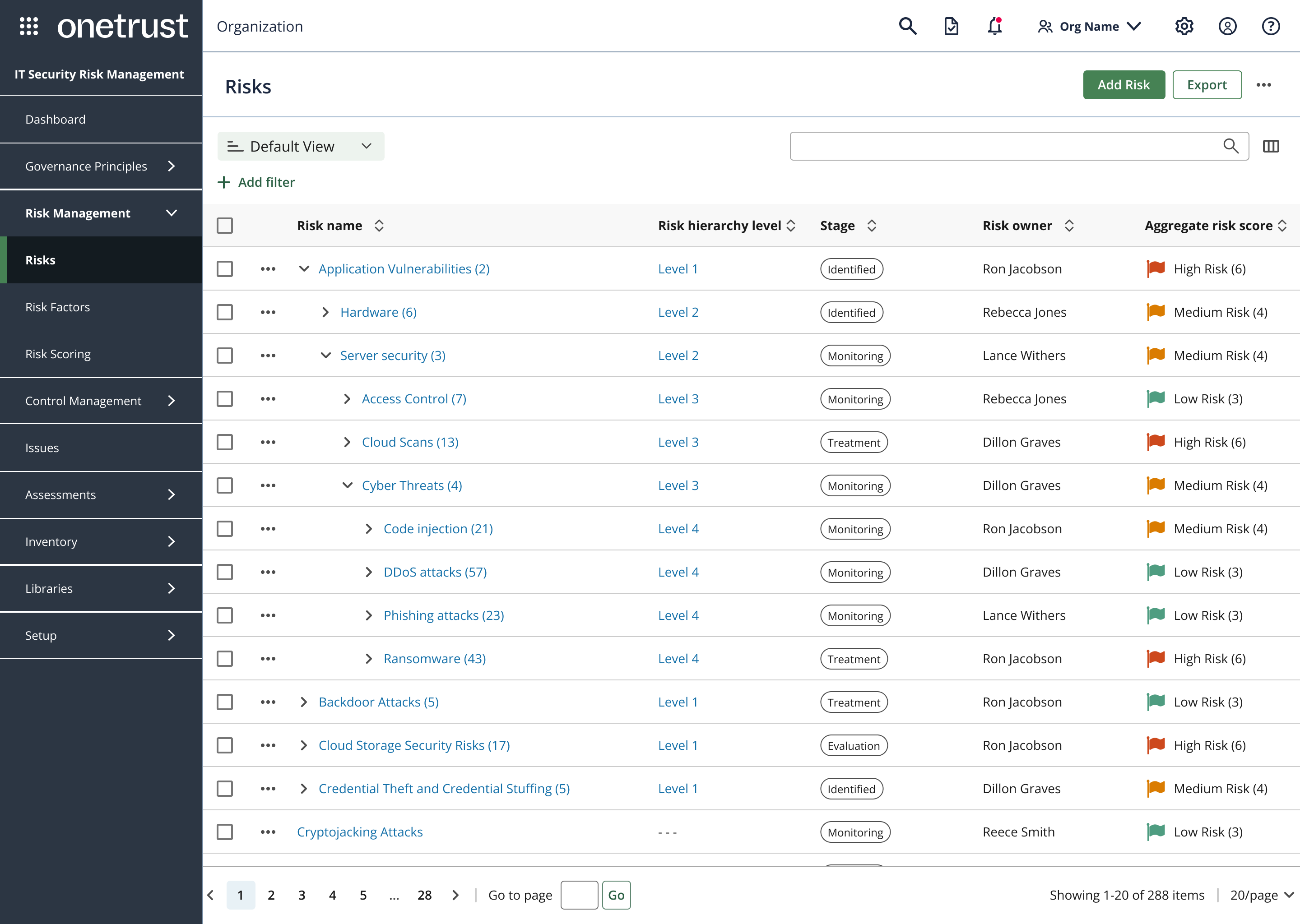
Strategic Risk Management Redesign
Problem
The existing risk management module was misaligned with the workflows of our highest-value enterprise clients. My goal was to validate core pain points across a massive revenue block and rebuild the design roadmap to address systemic usability and scalability issues.
How I tackled it
- 01
Revenue-Led Research
Conducted deep-dive interviews with 11 key enterprise customers representing $4.6M in ARR.
- 02
Thematic Synthesis
Aggregated raw feedback into high-level strategic themes to drive cross-functional alignment.
- 03
Backward Roadmapping
Worked backward from agreed-upon themes to define a multi-quarter execution plan.
- 04
Iterative Prototyping
Delivered high-fidelity designs that addressed the prioritized 'big rock' requirements first.
What we learned
This phase was defined by high-stakes discovery. By interviewing eleven enterprise customers with a combined $4.6 million in ARR, we moved past anecdotal feedback and identified the high-revenue friction points that mattered. We mapped the findings into a Key Findings matrix and learned the primary blockers weren't UI-deep — they were rooted in how risk data was aggregated and visualized at scale.
From insight to roadmap
The strategy used a Work Backwards model. Once leadership and engineering agreed on the themes from research, we built a roadmap starting from the ideal one-year vision. That let us prioritize a 3RR (Release Roadmap) focused on Critical Fixes in the first nine months while laying the architectural groundwork for advanced predictive risk modeling in year two.
Iteration to high-fidelity
Phase 1 — Thematic Alignment
Design started by translating customer themes into functional wireframes. I worked daily with Product and Engineering to make sure proposed solutions — improved risk scoring visibility, bulk-action workflows — were technically feasible. This stage was critical for proving our designs directly addressed the ARR-killing issues surfaced during research.
Phase 2 — High-Fidelity Execution
Moving into high-fidelity, we iterated on a modular risk dashboard that scales from mid-market to global enterprise. By pulling developers into refinement throughout the process, the complex data visualizations stayed performant. The final designs delivered a streamlined, high-trust experience for identifying, assessing, and mitigating enterprise-wide risk.
What it added up to
The redesign aligned the OneTrust Risk Management product with the needs of its most valuable customers. By grounding our design decisions in $4.6M of protected ARR, we secured executive buy-in for a long-term roadmap that reduced friction and solidified loyalty. The outcome was a more intuitive, scalable platform that turned risk from a compliance chore into a strategic business advantage.