Fonda Restaurant Onboarding & Dashboard Redesign
Streamlining the 0-to-1 merchant journey and architecting a scalable, data-dense dashboard to reduce onboarding friction and empower restaurant growth.
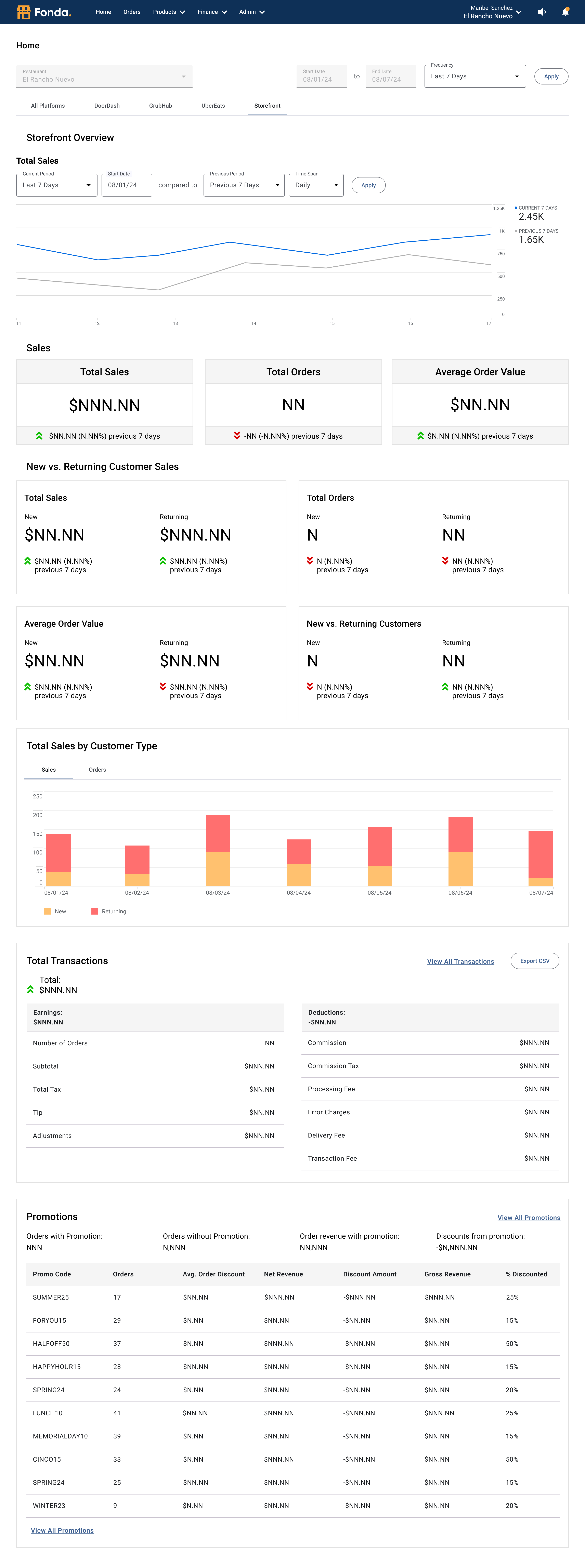
Fonda Startup Dashboard Redesign
Problem
In Spring 2024, Fonda's platform was losing users to a disjointed onboarding experience and a cluttered dashboard. I was brought in to streamline the 0-to-1 merchant journey and redesign the core interface so it would scale as the company's feature set expanded.
How I tackled it
- 01
Research & Discovery
Audited the existing dashboard and benchmarked against industry leaders like Toast and DoorDash.
- 02
Strategy & IA
Defined a 12-month roadmap and restructured information architecture to support complex menu management.
- 03
Iterative Design
Built low-fidelity flows and partnered with engineering to validate technical feasibility before high-fi polish.
- 04
Handoff & Execution
Delivered an end-to-end prototype and design system documentation for seamless development.
What we learned
We did a deep dive into the existing dashboard to surface friction points in the legacy UI. Benchmarking against eight-plus competitors — UberEats, DoorDash, and others — let us map out the essential features and menu flows. This phase cross-referenced user pain points with technical debt so the new strategy addressed both usability and backend constraints.
From insight to roadmap
Our strategy centered on a 12-month vision to transition from a basic interface to a robust business engine. We prioritized a modular Menu Flow that gave merchants granular control over categories and items. The roadmap kept the design functional as Fonda scaled to more restaurant customers.
Iteration to high-fidelity
Phase 1 — Architecture & Collaboration
Design started with a complete overhaul of the information architecture. I worked alongside engineering to validate components — every table, every toggle had to be buildable inside our sprint cycles. This dev-first mindset prevented late-stage redesigns and made the wireframe-to-code transition smooth.
Phase 2 — Iteration to High-Fidelity
Through several iterations we evolved the onboarding flow from a complex ten-step process into a streamlined sequence. Testing high-fidelity prototypes refined the visual hierarchy of the end-to-end dashboard, focusing on data density without sacrificing readability. Each iteration was backed by stakeholder feedback to align business goals with user needs.
What it added up to
The final redesign turned Fonda from a confusing black box into a transparent, self-service merchant experience. By simplifying the IA and shipping a modular menu management system, we empowered restaurant owners to manage complex menus without technical support. Initial setup friction dropped dramatically and the platform was finally able to scale alongside the company's growing feature set.